Thursday, November 11, 2010

New wave of attacks target Iraqi Christians

Our Lady of Salvation church after the
Oct. 31 attack (from Ankawa.com).
Less than two weeks after Islamist militants killed 58 individuals in an attack at Baghdad’s main Syriac Catholic church, further attacks have killed at least five Christians and injured 33 others.

Suspected Islamist militants detonated 11 bombs in Christian suburbs across the Iraqi capital on Tuesday evening and Wednesday morning, striking indiscriminately at shops and homes owned by members of the increasingly vulnerable minority.

In the aftermath of the church massacre, The Islamic State of Iraq, an al-Qaida front, announced its intention to open upon the country's Christians “the doors of destruction and rivers of blood.” It posted a statement on militant websites last week calling for the continual bloodshed of Christians in the Middle East.

“Baghdad right now is just gripped by terrorism against the Christian community and there is no other way to put it,” said Carl Moeller, president of Open Doors USA. “I’m using the word ‘religion-cide’ to explain to people what is really taking place in Iraq right now. Extremists are concentrating their efforts to eliminate Christianity from that country.” He noted how sad this effort is given that Christianity has been in the land that is now known as Iraq for two millennia.

Christians in Iraq have expressed frustration as well as desperation after the attack, saying that the Iraqi government only speaks word of protection but is unable to provide security for the beleaguered community. An Open Doors contact in Baghdad sent the following message on Wednesday:

“[T]errorists have started to kill the Christians in their houses in many different places of the city. My family and I are very stressed and afraid. It is very horrible and we are safe now, but maybe we are the next victims. Why is there no real safe place in Baghdad? Will we also leave Baghdad or not? We do not want to leave. We are born here. My family has lived here for ages and now I am forced to escape? What is this kind of world? Please pray for us to keep us safe until Friday, when we can get out for a few days.”

Continue to pray for the victims' families and for divine intervention.

Excerpted from The Christian Post and Assyrian International News Agency.

Wednesday, November 10, 2010

Bhutanese government may legalise Christianity

Bhutan
As Christians living in the Western world, it can be difficult to imagine daily life without Bibles, Christian literature and our pick of churches in a 15-kilometre radius. And, yet, there are populations of people in this world who are unable to freely worship or attend a church of their choice.

In the South Asian country of Bhutan, government officials recognise only Buddhism and Hinduism as the country’s two religions. As a result, only these two communities have the right to openly practise their beliefs and build places of worship.

That may soon change as Bhutan’s religious regulatory authority is expected to consider recognising Christianity before the year’s end.

For the first time in Bhutan’s history, the Buddhist nation’s government seems ready to grant much-awaited official recognition and accompanying rights to a miniscule Christian population that has remained largely underground. The authority that regulates religious organisations will discuss—at its next meeting in late December—how a Christian organisation can be registered to represent its community.

Thank the Lord that movement forward is being made. Pray for our fellow Bhutanese brothers and sisters and their efforts to share Jesus Christ with those around them. Pray that the meeting will take place in December and that God will move among those gathered and open hearts to hearing His name and the words of His people.

You can read more about the plight to legalise Christianity in Bhutan by viewing “Legal Status Foreseen for Christianity in Buddhist Bhutan” posted on Charisma Magazine.

Tuesday, November 9, 2010

PRAY: Pakistani woman sentenced to death

Asia Bibi and her family
VOM sources are reporting that Asia Bibi, a Christian mother-of-two, has been sentenced to death by a Pakistani court for blasphemy. She is the first Pakistani woman ever to receive this sentence for blasphemy.

Yesterday, a court judge gave Asia the maximum sentence at the end of a trial that lasted more than 16 months. Asia, a farm labourer in her late 30s from Ittanwali, Punjab province, was also fined more than the equivalent of an average worker’s two-and-a-half years’ salary. The decision comes as a crushing blow to Asia and her family as well as all Pakistani believers and those who have been praying for Asia’s release.

Police first filed a case against Asia in June 2009, after her local Muslim co-workers accused her of making derogatory comments against Islam’s prophet, Mohammed. VOM first reported on this story on June 24, 2009, and wrote an update last week about Asia languishing in prison.

Please pray for a reversal of the court ruling. Pray that God would soften the hearts of those in charge of Asia’s case. Pray God's perfect peace that surpasses all human understanding over Asia and her family.

Want to do more? You can voice your concern by sending emails directly to the offices of Pakistani President Asif Ali Zardari and Abdullah Hussain Haroon, the Permanent Representative of Pakistan to the United Nations.

Office of Pakistani President Asif Ali Zardari

ambassador@embassyofpakistanusa.org

Abdullah Hussain Haroon, the Permanent Representative of Pakistan to the United Nations

pakistan@un.int

For more information about writing to government officials, download a PDF of VOM’s letter-writing guide and prisoner list, “Doing time for God.”

Imprisoned in a shipping container

Ever imagined yourself living inside a metal shipping container? Of course not. Shipping containers are made for moving inanimate goods around the globe, not for human comfort, and certainly not for housing. So, imagine Helen Berhane’s shock when she found herself living in one. The reason? She was imprisoned in her homeland of Eritrea for refusing to deny Jesus Christ as her Saviour.

Below is peek into Helen’s dramatic experience of being persecuted for His name’s sake, as excerpted from Song of the Nightingale: One woman’s dramatic story of faith and persecution in Eritrea by Helen Berhane with Emma Newrick.
A single candle flickers, its flame barely illuminating the darkness. They never burn for more than two hours after the container door is locked: there is not enough oxygen to keep the flame alive any longer. It will go out soon.

The woman behind me shifts in her sleep and her knees dig painfully into my back. I try to wriggle over to give her more room, but I am already pressed up against another sleeping body. I pull my blanket up higher and curl up as much as I can. Despite the proximity of so many people, it is freezing cold. Condensation drips from the roof and slides down my cheek, and when it moistens my lips I taste rust. The air is thick with a dirty metallic tang, the ever-present stench of the bucket in the corner, and the smell of close-pressed, unwashed bodies.

I peer around, trying to work out where she is, the woman whose mind is gone. There is a dark shape standing by the small window hacked roughly into the side of the container. I stiffen. Sometimes she blocks the opening by stuffing her blanket into it, cutting off our limited supply of fresh air. Other nights she shouts and wails, rocking the container so that none of us can sleep. She is worse now there are more of us: 19 in a space that can only sleep 18. Tonight she is quiet, and it makes me uneasy.

But, I am so tired, and so I force my body to relax against the hard floor. Abruptly the candle snuffs out, I close my eyes, and think of my daughter: Please Lord, keep her safe.

The floor creaks. Someone must be getting up and stumbling across the sleepers to the toilet bucket. I try to shut the noise out. Suddenly, without warning, hands close on my neck like a vice. My eyes fly open, but it is too dark to see. Then there is a guttural snarl, and I know that it is her, the mad woman, her fingers tight on my throat. I push myself up but I have no breath to scream, and I am not strong enough to shake her off. So I do the only thing I can do: I bang my free hand on the wall of the container and kick out. All around us prisoners are waking up. One tries to pull her away from me, but now she has one hand on my throat and the other knotted in my hair, yanking it away from my scalp. I gulp down a breath and manage a scream. The other prisoners start to shout, too, and bang the sides of the container. There are shouts now coming from outside, and the sound of hurrying feet, the screech of the bolts sliding back and the pop as air rushes into the container, and then the doors are flung wide open.

My eyes burn as torchlight sears across my face, and then a guard is yanking her away from me and beating her about the head and body with his baton. I fall onto all fours, gasping in air. The guards pull her out of the container, and slam the doors again. The other women rush to crowd around the tiny window, so small that only one can see out. One does, and whispers, “They are beating her!” Her voice is low so as not to anger the guards, who do not like us to look out. She risks another glance. “They have tied her outside.” The others start to lie down again, looking forward to a few hours of sleep before the guards come again to march us to the toilet field.

I lie down, too, but my scalp feels as though it is on fire, and I know that I will not sleep tonight. Sometimes I cannot believe that this is my life: these four metal walls, all of us corralled like cattle, the pain, the hunger, the fear. All because of my belief in a God who is risen, who charges me to share my faith with those who do not yet know him, a God who I am forbidden to worship. I think back to a question I have been asked many times over my months in prison: “Is your faith worth this, Helen?” And, as I take a deep breath of the sour air, as my scalp sings, the mad woman rants outside, and the guards continue on their rounds, I whisper the answer: “Yes.”
Want to read more? You can order this book through The Voice of the Martyrs Online Catalogue.

For more information about the persecution of Christians in Eritrea, visit The Voice of the Martyrs' Eritrean Country Report.

Monday, November 8, 2010

8 house churches closed in Syria

Check out a 60-second Overcomers video...


To view more videos about the persecution of Christians around the globe, visit Persecution.TV.

Saturday, November 6, 2010

Iranian pastor to be held indefinitely

A little more than two weeks ago, VOM sources reported that Iranian Pastor Youcef Nardarkhani was sentenced to death by the Assize Court of the province of Gilan. Pastor Youcef, a leader in the Full Gospel "Church of Iran" network was arrested in October 2009, after protesting a decision by the government requiring that his son study the Qur'an. As of October 21, a formal verdict had not been delivered.

This past Friday, sources inside Iran confirmed that security officials informed the court not to deliver an official verdict, citing the amount of international attention the case is receiving. While the Iranian officials originally assumed they could hide their actions, the international attention has forced them to maintain appearances, thus deciding to neither deliver a sentence of death nor execute Pastor Youcef at this time.

Continue to pray for Pastor Youcef and his family, his release and his protection during this time of isolation.

To read more about the persecution of Christians in Iran, visit VOM’s Iran Country Report.

Friday, November 5, 2010

Won't you pray with us?

The plea of persecuted Christians remains unchanged: "Please, pray for us." Often their prayers are requests for strength. Many ask the Lord to make them mentally strong to withstand severe pressure to deny Him. Others ask for physical strength following violent attacks. Some cry in prayer for the ability to forgive their persecutors.

This November 14, Christians worldwide are setting apart an International Day of Prayer for the Persecuted Church (IDOP), as a special time to pray for the suffering Body of Christ around the globe. This year's theme is "Hearing Their Cry" from Psalm 10:17: "You hear, O Lord, the desire of the afflicted; you encourage them, and you listen to their cry."

There is still time for you, your friends and your church group to get involved in this exciting prayer initiative. Visit http://www.idop.org/ to find out more and to download special resources designed to equip you to pray for your persecuted family.

Thursday, November 4, 2010

Chinese authorities raid Christian's home

Last week, approximately 10 police officials raided the home of a Christian in Beijing, China, in an effort to search for Hua Huiqi, a formerly imprisoned pastor. Every room in the house was ransacked, including a bedroom belonging to a child. The officials questioned the homeowner about intentions to meet with foreigners later that evening.

In response to the incident, the owner later spoke these powerful words: "Because the Beijing police have crossed the line, and have blatantly and continually abused the basic rights of my entire family, I hereby announce that today I will begin to continually fast and pray. I will pray to the Lord to bless China and to fill it with righteousness! I also request, brothers and sisters, that you pray for me and my family, and that God may grant us freedom from fear!"

Pray that this believer will continue to set Christ apart as Lord without giving in to fear, always prepared to share Christ while living a holy life (1 Peter 3:14-17). Pray that other Christians facing opposition in China will also remain confident in Christ and look prayerfully and faithfully to Him. Pray that China will no longer violate the human rights of its citizens. Pray also for safety for Pastor Hua Huiqi.

*Image of Pastor Hua Huiqi is provided by ChinaAid.

Wednesday, August 18, 2010

Somalia's Christians plead for prayers during Ramadan

According to The Christian Post, Somalia’s underground Christian community is requesting prayer. You can read their report below:

somalia1 Somalia’s underground Christian community is asking fellow believers worldwide to pray for their safety during Islam’s holy month of Ramadan.

The tiny Christian population is regularly persecuted by Islamic extremists. They are requesting that fellow Christians pray they can live in peace with their Muslim neighbors. Ramadan began Aug. 11 and ends on Sept. 9.

“We are called criminal and apostate. What is our crime? We are Christians! We suffer because of what we believe,” said a Somali Christian, whose name is withheld for security reasons, to Open Doors USA.

“Please pray for all Somali Christians who suffer persecution to not seek revenge but commit their case unto God.”

Religious zeal and extremist activity generally increase in Somalia during Ramadan, noted Open Doors, a Christian persecution watchdog. Many Christians in Somalia must pretend to be practicing Muslims in order to remain safe.

A Somali Christian shared that after the suicide bombing last month in Uganda, the believer had to attend a Friday prayer meeting at the local mosque.

“I was there because I need to blend in with the crowd. That saves my life, my family and my colleagues,” the Somali Christian said.

When the prayer leader praised those behind the suicide bombing, people at the mosque shouted “Allahu Akubar,” which means “God is great.” The Christian joined with them even though the believer did not agree with the action of the suicide bombers.

“But this is the normal way things are for the Christian community in Somalia,” the Christian noted.

Somalia is ranked No. 4 on the Open Doors World Watch List of the worst persecutors of Christians.

In June, Compass Direct News reported that a 17-year-old girl who converted to Christianity was severely beaten for leaving Islam and was chained to a tree by her family.

An Islamic extremist group, called al Shabaab, which is linked to al Qaeda, is reported to be responsible for the murders of several Christians in Somalia.

Al Shabaab militants killed Mohammed Ahmed Ali, a convert to Christianity who led an underground church, in January. And in 2009, its members were behind the beheading of four Christians who worked for a local non-governmental organization that helps orphans in Southern Somalia. The Christians were converts from Islam and were beheaded for apostasy. News of their deaths was relayed to their families by an al Shabaab militant.

Somalia, which is located on the Horn of Africa, is one of the most lawless countries in the world. Chaos and tribal conflicts have plagued the country for the past two decades. The country also suffers from a humanitarian crisis in which 35 to 40 percent of the population depends on external assistance, according to the United Nations. Also, about 1.2 million Somalis are displaced because of fighting and droughts.

The U.N. Resident and Humanitarian Coordinator for Somalia said recently that assistance for Somalia this year is predicted to be between $300 to $400 million worth, down from $650 million last year.

“[W]e have critical gaps in assistance in some of the key areas where people need help,” said U.N. official Mark Bowden to China’s Xinhua news agency.

Despite the critical need, al Shabaad in August expelled three Christian humanitarian agencies. The Islamic insurgency group accused World Vision, the Adventist Development and Relief Agency, and Diakonia of using humanitarian work as a guise for spreading the Gospel.

The Christian organizations all denied the allegations and have temporarily suspended their operations.

Al Shabaad has also reportedly declared war on the United Nations and other Western non-governmental organizations that distribute aid in Somalia.

An estimated 4 million Somalis depend on humanitarian assistance to survive, according to the United Nations.

Somalia’s population is nearly all Sunni Muslim.

For more information about the persecution Christians face in Somalia, please click here.

Tuesday, August 17, 2010

Pray for kidnapped hostages in Yemen

yemen kk It can become far too easy, as time goes on, to forget the names and faces of our persecuted brothers and sisters we have prayed for in the past. This week, an update from Middle East Concern thankfully returned my attention to the kidnapped foreigners in Yemen who remain missing.

In your prayers today and in the coming weeks, please do pray for the hostages who remain missing and for those who have been returned to their families.

In recent months we have requested prayer following the kidnapping on Friday 12th June 2009 of nine foreigners in Saada, north-west Yemen, three of whom were murdered shortly afterwards. Recall that two were freed unharmed on 17th May.

yemen 2

There continues to be no news of Johannes and Sabine (a German couple), Simon (their son, aged 2) or of Tony (a British man). Lydia and Anna (5 and 4, daughters of Johannes and Sabine) who were freed in May are with relatives in Germany.

The Muslim fasting month of Ramadan started on Wednesday. Therefore, Johannes, Sabine and Tony (assuming they are alive) will probably be forced to fast during daylight hours, which are approximately 4:15 am to 6:30 pm in northern Yemen.

Christians in Yemen thank us for our prayers and request our continued intercession. Please pray that:

1. The missing four (assuming they are alive) will know the peace, presence and daily provision of Jesus and will be released unharmed shortly

2. They will lack nothing during Ramadan

3. Efforts by those seeking to secure their release will be successful

4. Lydia, Anna and their relatives will know the presence and peace of Jesus

5. The families and colleagues of those missing and murdered will know the peace of Jesus amidst continuing speculation and uncertainty

6. All expatriate Christians in Yemen will know the Lord’s guiding and protecting at this time

7. The perpetrators will be convicted by the Spirit and drawn to the forgiveness, love and true life offered by Jesus.

Friday, August 6, 2010

This week in Church history: James Abbes burned in Bury, England

James Abbes stripped off his clothes and shoes. Where he was going in a few minutes, he would not need them--new and glorious garments would be his. But here on earth, some poor folk might find his old garments helpful.

The crowd had come to see one of the burnings that were all too common in the sixteenth century. They would not be disappointed. And they heard words of encouragement, too. As James moved toward the stake, he urged the bystanders to cling to the truth and to seal the cause of Christ with their blood if need be--just as he was now doing. The young man seemed completely confident.

One of the sheriff's servants was cut to his heart by this talk. He cursed James' faith, calling it heresy and he mocked James as a madman. To England's ruling elite as well as to the sheriff's servant, James was a heretic. He held Reformation views during the reign of Queen Mary Tudor of England.

Earlier, when the bishop of Norwich learned of James' "heresy," he ordered him arrested. James wandered about to escape capture, but an informant turned him in. The bishop of Norwich convinced James to recant and gave him a piece of money to seal the bargain.

The money burned the young man's conscience. Although he knew it meant a cruel death, he came back to the bishop and threw down the coin, saying he had been wrong to accept it.

The bishop attempted to talk James out of the stand he was taking; but this time, there was no swaying him. He was given a mock trial and condemned to be burned.

… On August 2, 1555 the sheriff's men fastened James to a stake at Bury, England. As the fire was lit, he praised and glorified God. The flame rose around his body.

At that moment, according to John Foxe's account, the servant who had mocked James and called him mad went mad himself. Imitating James, he ripped off his clothes and shoes in front of the people, exclaiming, "Thus did James Abbes, the true servant of God, who is saved but I am damned." He repeated this line again and again.

Then, as Foxe tells it, "The sheriff had him secured, and made him put his clothes on, but no sooner was he alone, than he tore them off, and exclaimed as before. Being tied in a cart, he was conveyed to his master's house, and in about half a year he died..."

(Source: www.Christianity.com)

Friday, July 30, 2010

Indonesian Sunday School teacher passes away

The following story was released recently about the passing of Ratna Bangun, an Indonesian woman who was arrested along with two other Christians in 2005 (click here to learn more).

OLYMPUS DIGITAL CAMERA         A few days ago, Ibu Ratna Bangun died of lupus while confined at a hospital in Jakarta, Indonesia. Her husband and her two sons paid their last respects to Ibu Ratna on Wednesday in Hargeulis, her hometown.

Ratna Bangun was arrested in May 2005, with Dr. Rebekka Zakaria and Eti Pangesti, under false accusation of converting Muslim children to Christianity through a Sunday School program. All three women were given a three-year sentence on September 1, 2005 and were released from Indramayu prison on June 8, 2007…. While in prison, Ibu Ratna shared her reflections with Open Doors about being in prison:

“Before, I had always been surrounded by fellow believers. But now, I live among non-believers. I realize how hard it is to share God’s love and my life to them. It is also hard to live away from my children and  husband. But I am thankful – please note this carefully – that God’s faithful love has never left me. God has helped me through everything.

“Secondly, when Jesus broke the five loafs of bread and two fishes to feed 5,000 people, He turned nothingness into something. As for me, I feel like the insignificant breads and fishes. The suffering I face is nothing compared to what other believers around the world are going through. Just like the bread, I was crushed and distributed to become blessings for many people. I am being processed in this place.

“Thirdly, prison is a school of faith. This is where I fight for my faith, so that I could be a part of God’s plan; it is no coincidence that I am here, in this prison.”

What stood out to me in her reflections was her second point. It is amazing that she would view a situation in this way. What stood out to you?

Please pray for this dear family who has been through so much.

(Source: Open Doors)

Please take some time today to pray for those mourning her loss. Pray that they will rest in the knowledge that the Good Shepherd walks with them through this difficult time (Psalm 23). Pray that her Christ-like example will continue to inspire and challenge many. You can post a prayer of solidarity with those mourning on our Persecuted Church Prayer Wall. 

Wednesday, July 21, 2010

Letter to the editor: Islam a religion of peace?

"All the religions in the world teach only two things – love and peace."

Do you agree? George Vanner didn't, and so he wrote a letter to the editor of The Cambridge Times in response to an article that opened with the above claim. In his letter, George voices his disagreement and encourages the article's author to find out what is really happening to Christians and other minorities in Islamic countries today.

A friend of VOM recently mailed us the newspaper clipping and so I thought I would share it with you as well! Both the article and George's response can be read below. (By the way, if you are interested in writing to your local paper, click here for more information on how to get started.)

If you saw a similar article written in your local paper, would you write a letter to the editor? What would you write? How do you tell others about what is happening to Christians in Islamic countries today?

Veil not mandatory in Islam

Guest column-Yasmeen Sultana - Jun 09, 2010

All the religions in the world teach only two things – love and peace.

However, human beings, for their selfish motives, mould the religion, and create discrimination and hatred. This is about the Niqab or veil issue in Quebec.

Islam represents a religion of humanity, love and peace. Unfortunately, due to the wrong deeds of some misguided Muslims, the entire Islam community has been blamed in recent times. Islamic political values have always been misunderstood.

Is the Islamic political system a rival to democracy?

The word Islam refers to peace. Like all other religions, Islam teaches its followers to live harmoniously with fellow human beings. Islam does not practice any form of compulsion. This religion does not tolerate oppression.

The purpose of Muslim communities is to promote the principles of Islam and help Muslims get their due respect. Religion always teaches peace, but they are people who use religion incorrectly for their own purpose.

The veil is not a mandatory injunction of the Qur’an. Women must cover their body and head properly, but not the face.

If veiling a face was an Islamic ideology or an order of the Qur’an, then why do Muslim women not cover their faces on occasion of holy Hajj (third part of Islam) and Umra? Muslim women are not ordered in the Qur’an to veil their faces at Hajj and Umra – the ultimate forms of Islamic rituals. In Hajj and Umra, men and women are in close proximity in a very crowded space.

Islam has fallen into the same category where it can be identified by its dress, just like a Catholic priest or a rabbi. On the contrary, Islam stresses morality of intentions, behaviours and actions.

Instead of following principles of a dress code, a specific dress has itself become the principle. It is a classical example of maintaining the shell of the religion.

Globalization and the freedom of thought that it provides give us individual freedom to choose a dress of our liking. But I see it as a problem when a given dress is worn and enforced in the name of Islam.

Clearly the Qur’an defines basic standards of a dress: raiment that covers your nakedness.

And the purpose of dress: a source of (your) elegance and protection.

Goal of a dress: so that they may attain eminence. Body can be covered with a big fabric sheet. There are no such words of Burqa in Qur’an.

Niqab defines the above requirements of a dress, i.e. it neither covers nakedness nor is a source of elegance; yet in present times is a source of scrutiny thus denying the protection except that of a sun blocker.

It is someone’s own choice, like some Sikhs do not wear a pug ad on their head or, in 1996 in Canada, women are given choices to jog topless. Finally the veil is not the basis of Islam or Qur’an.

It is against Canadian values of hiding your own identity in common day life and being Canadians, we have to respect Canadians laws.


Islamic religion not so peaceful

In response to the guest column of Yasmeen Sultana, Veil not Mandatory in Islam, June 11.

In her letter she says, “The word Islam refers to peace”.

The main meaning of the word Islam is Submission to their God, not peace. She also says, “Islam does not practice any form of compulsion.

This religion does not tolerate oppression.”

If this is true as she claims, then organizations like The Voice of the Martyrs would not have to report that Islamic authorities are doing what she says they don’t do.

Not only are minority Christians under compulsion and oppression in these countries, many are suffering with beatings, rape, kidnapping, forced marriages, forced conversions.

I suggest Ms Sultana check out the website www.persecution.net to see what is happening in many of these Islamic countries.

George Vanner
Cambridge

Tuesday, July 20, 2010

Iran: An addict becomes a Christian, so do others

Zara was a drug addict living half a life in a very religious city. Zara met some Christians and desperate for anything to deal with her drug problem, she asked Christ into her life. The addiction demons went. And Zara could not stop talking. First some family members came to Christ, and then friends heard about her. Now there are at least ten who have come to faith because of her salvation, and they meet together. No law of man can stop the living Christ reaching into the lives of those oppressed by Satan. And no law of man can stop people like Zara talking about their Saviour.

The case of Ali Golchin, jailed solely because of his allegiance to the historic faith of the church, is one of many that tell us that the church suffers in Iran. The case of Zara is one of thousands, if not hundreds of thousands, that tells us that Jesus Christ Himself is building his church, as usual among the poor and distressed.

Pray for:

  • Zara’s group to grow
  • Other addicts to come to faith
  • Ali Gochin to be released

(Source: Elam)

Friday, July 16, 2010

This week in Church history: 12 Carthage Christians martyred

Vigellius Saturninus, the proconsul (Roman administrator) of North Africa in 180 A.D., spoke generously. "You can have the forgiveness of our Lord the Emperor if only you return to your senses," he said.

Speratus, one of twelve Christians who faced him, replied for the rest. "We have never done evil; we have not lent ourselves to wrong; we have never spoken ill, but when ill-treated we have given thanks, for we pay heed to our Emperor."

Evidently Saturninus was stung by that reply. "We too are religious, and our religion is simple," he said defensively. "We swear by the genius of our Lord the Emperor, and pray for his welfare, as you also ought to do."

Speratus offered to instruct Saturninus in true simplicity of worship, but the proconsul brushed him off and turned to the other offenders. "Abandon this way of thinking," he commanded.20717

Speratus reminded Saturninus that to murder and to lie were the real evils, not the Christian faith. Saturninus ignored him and addressed the other Christians. "Don't share his folly!" he urged them. But the others (five were women) responded as firmly as Speratus.

Cittinus said, "We have no other to fear, save only our Lord God, who is in heaven." Donata added, "Honor Caesar as Caesar; but it is God we fear." Vestia declared, "I am a Christian." Secunda assured the proconsul, "What I am, that I wish to be."

Saturninus turned back to Speratus. "Do you persist in being a Christian?" he asked.

Speratus never wavered. "I am a Christian," he replied, and all the others agreed with him.

Saturninus offered them time to reconsider. To that dangerous bait Speratus answered, "In a matter so plain, we don't need to consider."

Saturninus changed the direction of his inquiry. What were the documents he had found in Speratus lock box? he asked curiously.

"Books and letters of Paul," answered Speratus.

The proconsul made one last effort to change the minds of the Christians. When he saw that they would not bend, he read his decision from a tablet. Heralds then announced his decree: "Speratus, Nartzalus, Cittinus, Veturius, Felix, Aquilinus, Laetantius, Januaria, Generosa, Vestia, Donata, and Secunda, I have ordered to be executed."

The Christians responded with joy. "Thanks be to God," they exclaimed. This was their chance to show their love for Jesus! On July 17, 180, they were beheaded for the sake of Christ, at Scilli, near Carthage, North Africa.

(Source: www.Christianity.com)

Wednesday, July 14, 2010

Nepal: Pastor beaten by Maoists

Our friends at VOM-USA recently posted the following story about an attack on a prayer meeting in Nepal. Please remember these believers in your prayers today!

On June 13, Maoist rebels in Nepal attacked Christians at an evening prayer meeting, according to VOM contacts. The rebels ordered them to stop the meeting and then assaulted the pastor and believers when they refused.

Before the attack, the pastor had asked the Maoists to leave and return the next day to talk with him, but the rebels instead began to beat him with sticks. When church members, including the pastor’s father and women in the church, tried to defend the pastor, the Maoists attacked them, too. The rebels also burned Bibles and hymnals during the attack.

The following day, local villagers accused the Christians of not paying the “temple tax” and of “converting the local people to Christianity.” Each family was ordered to pay the exorbitant tax, and Christians have been warned that they will be expelled from the village if they do not pay. Some believers have voluntarily left the village, and those remaining risk losing their homes.

Pray that God will heal the pastor and others who were beaten during this attack. Pray that they will look to Christ for strength and direction and that their testimonies will draw nonbelievers into fellowship with Christ.

Tuesday, July 13, 2010

Colombia: "Christians are dangerous!"

The Revolutionary Armed Forces of Colombia, also known as the FARC guerrillas, have inflicted violence upon Colombians for the last 40 years. Guerrilla leaders are constantly recruiting children to join their Marxist movement to replace the children and young adults who are killed. Those who speak against the violence or encourage others not to join the guerrillas are targeted, especially Christian leaders, like Dora and Ferley.

Dora and Ferley Dora Lilia Saavedra and her husband, Ferley, spoke freely about Christ to the children they taught in Santana Ramos, a farming village deep in the Colombian jungle and a hotspot for guerrilla violence. Each day children ages six to 12 piled into Dora's one-room, wooden schoolhouse and listened to her talk about Jesus, but this was risky. She was luring more away from the guerrillas’ cause. Guerrillas also didn’t like Dora’s commitment to truth. “Christians are dangerous,” they repeatedly said. “Christians cannot lie. If the army asks them about us, they will tell the truth.”
One day, while Dora was in the schoolhouse, a neighbour told her some shocking news: guerrillas were going to kill her and her husband the next day. Even though the neighbour was a guerrilla sympathizer he felt bad for the couple. “You can take your family and run,” he said. “You can leave this village right now.” Calmly, Dora told the messenger not to worry, reassuring him that she and her husband were ready to meet their Lord.

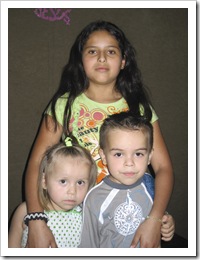
Marcella, Lydia, and JeffreyAfter the neighbour’s warning, Dora and her husband had a final devotion with their three children. The couple spent all night praying and fasting.
The following school day was like any other until around 10 a.m., when two armed guerrillas entered the school. “There will be no more school today!” one shouted. “Go home and return tomorrow.” The children quickly filed out the door as the guerrillas ushered Dora and her family to the back of the schoolhouse. They told Dora and her husband to say goodbye to their children. Suddenly more guerrillas burst into the room. One of them pointed to 12-yearold Marcella, saying, “We will kill her first.”

“No, please,” Dora pleaded as she stepped in between the guerrilla and her daughter. “It is me you want. Take me. Leave her here and take me now.”

Marcella cried as the armed men walked her parents across a field to a river just 300 yards away from the school. They ordered Dora and Ferley to lie face down on the ground. Marcella could not see her parents, but she remembers hearing the two shots as her parents were executed.

Just months after Marcella's parents were murdered, she said, "If I met the men who did this I would forgive them. I know this would be hard, but I know God forgives them. So I have to as well.” When asked what she would say to others who have to live with bad things happening to them, Marcella said: “In the name of Jesus nothing just happens.”

Young Marcella demonstrates the assurance that even in times of great suffering and loss, God is at work in the lives of His children. She is among many of the Christians taking a stand for Jesus in nations hostile to Christ.

1You can read the full article and other testimonies of courageous believers from around the world in our Special Edition newsletter. Click here to sign up for your free copy today!

Friday, July 9, 2010

This week in Church history: Procopius, first of the Palestine martyrs

30708When the Roman Emperor Diocletian launched the last and most ruthless of the ten Roman persecutions against Christians, his first victim in Palestine was a young man named Procopius. Eusebius was alive at the time. The Christian author, who became bishop of Caesarea and wrote the most famous history of the early church, left an account of the martyr: 

"The first of all the martyrs who appeared in Palestine was named Procopius. In truth he was a godly man, for even before his confession he had given up his life to great endurance: and from the time that he was a little boy had been of pure habits, and of strict morals: and by the vigor of his mind he had so brought his body into subjection, that, even before his death, his soul seemed to dwell in a body completely mortified, and he had so strengthened his soul by the word of God that his body also was sustained by the power of God. His food was bread only, and his drink water; and he took nothing else besides these two. Occasionally he took food every second day only, and sometimes every third day; oftentimes too he passed a whole week without food.

"But he never ceased day nor night from the study of the word of God: and at the same time he was careful as to his manners and modesty of conduct, so that he edified by his meekness and piety all those of his own standing. And while his chief application was devoted to divine subjects, he was acquainted also in no slight degree with natural science. His family was from Baishan; and he ministered in the orders of the Church in three things: First, he had been a Reader; and in the second order he translated from Greek into Aramaic; and in the last, which is even more excellent than the preceding, he opposed the powers of the evil one, and the devils trembled before him.

"Now it happened that he was sent from Baishan to our city Caesarea, together with his brother confessors. And at the very moment that he passed the gates of the city they brought him before the Governor: and immediately upon his first entrance the judge, whose name was Flavianus, said to him: 'It is necessary that thou shouldest sacrifice to the gods': but he replied with a loud voice, 'There is no God but one only, the Maker and Creator of all things.'

"And when the judge felt himself smitten by the blow of the martyr's words, he furnished himself with arms of another kind against the doctrine of truth, and, abandoning his former order, commanded him to sacrifice to the emperors, who were four in number; but the holy martyr of God laughed still more at this saying, and repeated the words of the greatest of poets of the Greeks [Homer], which he said that 'the rule of many is not good: let there be one ruler and one sovereign.'

"And on account of his answer, which was insulting to the emperors, he, though alive in his conduct, was delivered over to death, and forthwith the head of this blessed man was struck off, and an easy transit afforded him along the way to heaven. And this took place on the seventh day of the month Heziran, in the first year of the persecution in our days. This confessor was the first who was consummated in our city Caesarea."

Over time, Eusebius' simple account became greatly exaggerated. So many conflicting details were added that the makers of church calendars became confused and honored three different men named Procopius! His feast is on July 8.

(Source: Christianity.com)

Thursday, July 8, 2010

Write to Pakistani Christian imprisoned for blasphemy

prisoner_204_image On July 1, 2009, Pakistani police arrested Imran Ghafur in Punjab province after Muslims accused him of burning pages of the Qur’an. While cleaning his brother’s retail shop, Imran removed the trash he had collected, intending to burn some of it. While burning the trash, pages of an Islamic book flew into the fire and burned. Imran’s neighbour, Haji Liaqat, saw the burned pages of the Islamic book and alerted other Muslims in the area.

“Haji Liaqat saw the burned pages, and he aggressively told all resident people and travelers that Imran burnt the pages of a Qur’an also,” a VOM contact said. “He was telling everybody that Imran Ghafur is burning the Qur’an … he should be killed.”

Imran and his father were severely beaten before police arrested Imran. Following the arrest, news of the incident spread throughout the city, and angry Muslims threw stones at the police station where Imran was being held. “Give the death sentence to him who disgraces the Holy Qur’an, and hang him who disgraces the Holy Qur’an,” the Muslims said. “Christians are dogs; Imran is a dog,” they shouted.

On July 2, 2009, Imran was moved to a jail. “The situation is very tense in Hajwari town, where the Christian families live,” the VOM contact said. “Haji Liaqat and his friends are saying that they will not allow Imran’s family to live in the colony or run their business.”

Imran and his family have been managing businesses in the area and are actively involved with other Christians in the area.

Write a letter of encouragement to Imran today, reminding him that Christians in Canada and around the world are aware of his plight and are praying for him. Please do not mention The Voice of the Martyrs in your letter or write anything negative about Pakistan’s government.

You can compile a letter to Imran in his own language online at www.PrisonerAlert.com or write to him directly at:

Imran Ghafur
Central Jail of Faisalabad
Faisalabad
Pakistan

For more information on writing letters to prisoners, please click here. To write to other Christians who are imprisoned for their faith, click here.

Friday, July 2, 2010

Orissa riot sentence 'falls short of justice'

India (Sep 2009) 368[4]It has been nearly two years since anti-Christian violence erupted in India's Orissa state. The attacks claimed the lives of approximately 100 Christians while dozens of church buildings and homes were destroyed (click here to read more about these attacks). 

Justice and peace remains elusive for Christians in Orissa. Many believers remain in relief camps, unable to return to their villages due to threats from militant Hindus. Others no longer have homes to return to. Churches that were destroyed in the violence remain in ruins.   

According to Union of Catholic Asian News, two men were recently convicted of culpable homicide and sentenced to six years' imprisonment for burning alive a paralytic man on August 24, 2008. The lenient punishment has disappointed local Christians, who fear such light sentences could encourage more crimes.

You can read the full report below:

India (Sep 2009) 357A verdict of culpable homicide for two Indian men accused of killing a paralyzed Christian during anti-Christian riots in Orissa has disappointed Church people.

The lenient punishment of six years’ jail for the two would encourage more crimes, said Father Dibakar Parichha, a lawyer assisting the 2008 riot victims. “It was the gruesome killing of a man, who could not move out of his bed.”

A court on June 30 convicted Sushanta Sahu and Tukuna Sahu of culpable homicide not amounting to murder and sentenced them to six years’ jail for killing Rasananda Pradhan. It also fined them 5,000 rupees (US$111).

Pradhan, a paralytic, was burnt alive when his house was set on fire by Hindu extremists on Aug. 24, 2008, according to the prosecution.

“I am disappointed at the prosecution and investigation that has led to the judgment,” said Bishop Sarat Chandra Nayak of Berhampur.

“If there is no justice, people would lose confidence” in the legal system, the prelate said.

India (Sep 2009) 372 Pradhan’s brother Ravinder also expressed dissatisfaction over the outcome of the case as the men were not convicted for murder. “There are other accused still to be arrested and prosecuted,” he said.

A total of 831 riot cases have been registered and two fast-track courts are processing 189 cases. The courts have tried 87 cases as of June 28, acquitting 621 people and convicting only 154 people, Father Parichha said.

The seven week-long riots in the state killed 93 people, destroyed some 5,000 houses and displaced 50,000, according to Church records.

Please continue to pray for Christians in Orissa as they rebuild their lives. Pray that, in the midst of such injustice, they will have the patience to entrust true justice into the hands of God (Romans 12:17-21).