Showing posts with label violence. Show all posts

Friday, May 27, 2011

Colombian Christians facing increased and intense violence

Pray for Colombian believers
as violence intensifies.
Colombian Christians are on high alert as intense and deadly violence continues in the country, report VOM sources. On May 12, a bomb exploded in Puerto Lleras, killing several policemen and injuring bystanders.

For several months, members of Colombia's main Marxist rebel group, the Revolutionary Armed Forces of Colombia (FARC), have been openly killing individuals in town streets and burning buses throughout the region.

FARC guerillas have also been conducting an internal purge, reportedly killing many of their own men and accusing them of being traitors to the Communist cause. It is suspected that many of those killed were secret Christians.

“In all our years in Colombia, we have never seen it this unstable,” said a VOM contact. “Yet we believe that this is also the most opportune time that we have ever seen for the gospel.”

You can help by praying!
Pray for those working to supply Bibles to Colombian believers in this region, as the need is reportedly very great. Pray the various other ministry efforts of Christian workers in Colombia will be effective. Ask God to guide and sustain new believers as they serve Him in a climate of intense and ongoing violence. Pray those who persecute Christians in Colombia will repent and embrace Christ as Lord.
Want to know more about persecution in Colombia? Check out the newest edition to the Restricted Nation series, Restricted Nations: Colombia. Click here to order yours today for $7.

Tuesday, May 24, 2011

Prayer requests for Egypt

Last week, Middle East Concern requested prayer following violent clashes between Christians and Salafi Muslims in Imbaba, Egypt.

Twelve people were killed (Christians and Muslims), many injured and arrested, and two church buildings and numerous Christian homes were damaged by theft, looting and arson.

In response, the government reaffirmed its determination to tackle sectarian violence.

There are two developments requiring continued prayer.

First, the Supreme State Security Prosecution has started legal proceedings against 23 Salafi Muslims allegedly involved in the Imbaba incident. The charges used include terrorism, premeditated murder, vandalism of public and private property, and intimidating citizens.

Second, the government has announced it is considering re-opening a number of church buildings that were closed under President Mubarak. Sixteen have already been approved for re-opening, of which at least three have already been opened. More re-openings are expected this week provided the authorities are satisfied that adequate security measures are in place.

Fear of sectarian incidents was one factor in the original decisions to close the buildings.

Regrettably, one re-opening was marred by a sectarian clash on May 19. As a group of Christians approached the Church of the Virgin in Ain Shams, Cairo, a crowd of Muslims, including Salafis, tried to block their way. The two groups threw stones at each other. Police quickly restored order and made some arrests. The Christians then approached the church via a back route. No injuries were reported.

Egyptian Christians request our continued prayers.
  • Pray authorities will fulfil their commitment to bring all perpetrators of sectarian violence to justice
  • Pray the re-opened church buildings will be well used
  • Pray further re-openings will happen peacefully
  • Pray security measures will prove adequate
  • Pray the bereaved will know the comfort of Jesus
  • Pray the wounded and traumatized will know the healing touch of Jesus
  • Pray church leaders will know the Spirit's enabling as they pastor their congregations and deal with community leaders
  • Pray the Good News of Jesus will be made available to all that seek it

Monday, May 9, 2011

Muslim attackers kill 17 Christians in Nigeria

Charred remains of Assemblies of God
church in Kafanchan, Kaduna state
International Christian Concern (ICC) has learned that Muslim attackers killed 17 Christians yesterday, including the wife and three children of a pastor, and burned down several Christian homes in the village of Kurum, Bauchi state, Nigeria.

Christians have suffered many casualties in northern Nigeria since April 16, after supporters of Muslim presidential candidate Muhammudu Buhari lost the federal election to Goodluck Jonathan, a Christian.

Many Muslim voters claimed voter fraud, although international observers praised the polls as the fairest since 1999.

Reportedly, as many as 300 Christians have been slain, with 14,000 fleeing their homes after Islamic attacks. 

Over the weekend Christian leaders in northern Nigeria called for a federal probe into the post-election violence, saying more than 200 church buildings were burned.

Click here to read an update on the violence by Compass Direct News.

Monday, January 24, 2011

Death sentence for perpetrator of attack on Egyptian Christians a year ago

Christian leaders are hopeful
the government will take effective
action to address violence
against Christians.
Middle East Concern shared a prayer request with us for Egyptian Christians today.

On January 6, 2010, six Christians and a Muslim security guard were killed in a drive-by shooting as worshippers left a Christmas Eve service in Nag Hammadi. Three men were arrested shortly afterwards. On January 16, 2011, they were convicted. The man convicted of firing the shots was convicted of first-degree murder and "intimidating citizens,” and given the death penalty. The sentences for the two accomplices are scheduled to be announced on February 20.

These verdicts come in the same month as the deadly attacks on Christians on January 1, in Alexandria, and January 11, on a train in Minya province. Egyptian Christian leaders hope that the severity of the sentence imposed is a sign that the judiciary and government will start to take effective action to address violence against Christians.

In the week prior to the January 16 hearing, Egypt's President Mubarak reportedly urged senior judges to speed up trials because "slow justice" breeds bitterness.

Please continue to pray for Egyptian Christians:
  • Pray those bereaved, wounded and traumatised in attacks on Christians will know the comfort, presence, peace and healing of Jesus.
  • Pray the justice system will consistently apply due process in investigating attacks, prosecuting those charged and imposing effective sentences of those convicted.
  • Pray that the perpetrators of violence against Christians will know the Spirit's conviction of sin and the Father's offer of forgiveness and life
  • Pray all officials involved will love mercy, act justly, learn about Jesus and choose to follow Him.
 

Tuesday, November 30, 2010

500+ Iraqi Christian families flee

The Assyrian International News Agency is reporting that Iraqi Christians are continuing to flee their country, with 507 families moving to the Kurdish north, where security measures are relatively stable. Many more families have fled directly abroad, mainly to Syria, Jordan and Turkey.

Despite calls for them to stay, many Iraqi Christians feel they have no future left in the country. This follows violent attacks against Iraqi Christians, which you can read about here, here and here.

Churches in Baghdad are reported to be almost empty with senior Christian clergymen fearing that Iraq is on its way to losing its Christian minority. Baghdad was the last remaining city with a sizeable Christian community, but thousands have fled the latest upsurge in anti-Christian violence.

Pray for the nation of Iraq. Pray for anointed leaders who can act with wisdom, courage and integrity. Pray that God will heal this land and its people. Pray that Christians might persevere in this difficult situation; pray also for their protection.

You can read the full story here.

Wednesday, July 14, 2010

Nepal: Pastor beaten by Maoists

Our friends at VOM-USA recently posted the following story about an attack on a prayer meeting in Nepal. Please remember these believers in your prayers today!

On June 13, Maoist rebels in Nepal attacked Christians at an evening prayer meeting, according to VOM contacts. The rebels ordered them to stop the meeting and then assaulted the pastor and believers when they refused.

Before the attack, the pastor had asked the Maoists to leave and return the next day to talk with him, but the rebels instead began to beat him with sticks. When church members, including the pastor’s father and women in the church, tried to defend the pastor, the Maoists attacked them, too. The rebels also burned Bibles and hymnals during the attack.

The following day, local villagers accused the Christians of not paying the “temple tax” and of “converting the local people to Christianity.” Each family was ordered to pay the exorbitant tax, and Christians have been warned that they will be expelled from the village if they do not pay. Some believers have voluntarily left the village, and those remaining risk losing their homes.

Pray that God will heal the pastor and others who were beaten during this attack. Pray that they will look to Christ for strength and direction and that their testimonies will draw nonbelievers into fellowship with Christ.

Friday, July 2, 2010

Orissa riot sentence 'falls short of justice'

India (Sep 2009) 368[4]It has been nearly two years since anti-Christian violence erupted in India's Orissa state. The attacks claimed the lives of approximately 100 Christians while dozens of church buildings and homes were destroyed (click here to read more about these attacks). 

Justice and peace remains elusive for Christians in Orissa. Many believers remain in relief camps, unable to return to their villages due to threats from militant Hindus. Others no longer have homes to return to. Churches that were destroyed in the violence remain in ruins.   

According to Union of Catholic Asian News, two men were recently convicted of culpable homicide and sentenced to six years' imprisonment for burning alive a paralytic man on August 24, 2008. The lenient punishment has disappointed local Christians, who fear such light sentences could encourage more crimes.

You can read the full report below:

India (Sep 2009) 357A verdict of culpable homicide for two Indian men accused of killing a paralyzed Christian during anti-Christian riots in Orissa has disappointed Church people.

The lenient punishment of six years’ jail for the two would encourage more crimes, said Father Dibakar Parichha, a lawyer assisting the 2008 riot victims. “It was the gruesome killing of a man, who could not move out of his bed.”

A court on June 30 convicted Sushanta Sahu and Tukuna Sahu of culpable homicide not amounting to murder and sentenced them to six years’ jail for killing Rasananda Pradhan. It also fined them 5,000 rupees (US$111).

Pradhan, a paralytic, was burnt alive when his house was set on fire by Hindu extremists on Aug. 24, 2008, according to the prosecution.

“I am disappointed at the prosecution and investigation that has led to the judgment,” said Bishop Sarat Chandra Nayak of Berhampur.

“If there is no justice, people would lose confidence” in the legal system, the prelate said.

India (Sep 2009) 372 Pradhan’s brother Ravinder also expressed dissatisfaction over the outcome of the case as the men were not convicted for murder. “There are other accused still to be arrested and prosecuted,” he said.

A total of 831 riot cases have been registered and two fast-track courts are processing 189 cases. The courts have tried 87 cases as of June 28, acquitting 621 people and convicting only 154 people, Father Parichha said.

The seven week-long riots in the state killed 93 people, destroyed some 5,000 houses and displaced 50,000, according to Church records.

Please continue to pray for Christians in Orissa as they rebuild their lives. Pray that, in the midst of such injustice, they will have the patience to entrust true justice into the hands of God (Romans 12:17-21).  

Monday, June 28, 2010

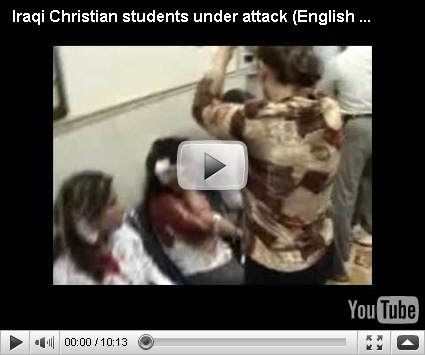
Students receive hospital treatment following bomb attack in Iraq

On May 2, a convoy of buses carrying Christian students to the University of Mosul was targeted in a bomb attack. A roadside bomb followed by a car bomb reportedly exploded in the area of Kokjaly as the buses were clearing a checkpoint staffed by U.S., Iraqi, and Iraqi Kurdish soldiers (click here for more information).

The video below shows the students receiving treatment at a hospital immediately after the bombing. As you watch, please pray for these students and their families. Pray for peace for the Christian community in Iraq. Please be advised that the footage contains scenes of blood.

Thursday, May 6, 2010

Nigerian president dies

Yesterday the world learned of the death of Nigeria’s president, Umaru Yar'Adua. Today, acting President Goodluck Jonathan -- who had been running the nation for months during Yar'Adua's illness -- was sworn in as president.

Those aware of the political and religious tensions in the nation, which recently culminated in horrific incidents of violence between Muslims and Christians (click here for more), have reacted to the news with much trepidation over how this sudden shift could intensify the instability. It is most certainly a time to lift up Nigeria in prayer.

  • Pray that the peace of Christ will continue to fill Nigeria, bringing forth reconciliation and stability
  • Pray that those in power will act justly toward all citizens
  • Pray that Christians in Nigeria will demonstrate God’s love, even amid adversity
  • Pray that one law, with equality for all, will govern the nation

The follow article gives an informative summary of some of the challenges Nigeria faces in light of the recent change in power:

Nigeria's shaky balance of power takes a hit as new president is sworn in

Reporting from Johannesburg, South Africa

Nigeria swore in Goodluck Jonathan as president Thursday after the death of his predecessor, sparking fears of a debilitating power struggle in the ruling party.

Politicians hailed the smooth power transfer, but the death of President Umaru Yar'Adua on Wednesday night after a long illness threw open the possibility of a fierce battle between the northerners and southerners in the ruling People's Democratic Party should Jonathan decide to run for the presidency in elections due next year.

If Jonathan contests, it would shatter an unwritten deal in the PDP, vital to Nigeria's political stability, which rotates the presidency for eight years to a leader from the mainly Christian south and eight years to someone from the mainly Muslim north.

The agreement, known as the "zoning" policy, was recently affirmed by the party and means an Islamic candidate should run as the PDP candidate because Yar'Adua, a Muslim, served less than four years.

But differences over the zoning policy between top ruling party figures underscore the divisions and unfolding battle for power.

Jonathan, a southerner who as vice president has been serving as the country's interim leader in recent months, has made no announcement on whether he intends to run. But some political figures in the ruling party and opposition said Thursday he would lose out on votes in the north, the country's larger voting constituency.

After he was sworn in Thursday, Jonathan said he took office in sad and unusual circumstances and described Yar'Adua as a man of integrity and humility. He declared a week of mourning.

Yar'Adua was due to be buried later Thursday in his northern home city of Katsina, where he presided as governor from 1999 to 2007 before taking office as president.

Yar'Adua's frequent bouts of illness undermined his presidency and prevented him from delivering on pledges to reform Nigeria, attack corruption and implement the rule of law.

He had suffered a kidney ailment since the 1990s. Last November, he flew to Saudi Arabia for medical treatment for pericarditis, inflammation of the sac around the heart. He failed to formally hand over executive powers to Jonathan and was never seen in public again.

The legislature's vote to hand executive powers to Jonathan in February was condemned by some lawyers as unconstitutional – and Yar'Adua's return soon after deepened the political crisis.

Presidential aides were accused of trying to cling to power, with Yar'Adua on his death bed. Jonathan was repeatedly prevented from meeting the president. Yar'Adua never addressed the public, and no clarity on his health was offered before Wednesday's announcement of his death.

PDP Chairman Vincent Ogbulafor said recently the presidency would remain with the north after the 2011 elections, in accordance with the zoning policy.

Nigeria, the world's eight-largest oil exporter and Africa's most populous nation with 150-million people, is almost equally divided between northern Muslims and southern Christians.

Since independence in 1960, the volatile and ethnically diverse nation has suffered chronic bouts of ill governance, whether by military or civilian rulers. Billions of dollars in oil wealth have been stolen or squandered by the corrupt political elite.

Yar'Adua was widely seen as a man of integrity and honesty. He came to office promising reform, but he lacked the political strength to counter widespread corruption.

In recent years, the country has been wracked by violence in the volatile oil-producing Niger Delta, with attacks on oil facilities and kidnappings by rebel groups demanding independence for the region. Yar'Adua, determined to increase flagging oil exports, succeeded in establishing a shaky peace in the region by introducing an amnesty for rebels, many of whom surrendered arms.

But there were other flare-ups, with renewed ethnic and religious violence in Plateau state, central Nigeria, that left hundreds dead in the last few months.

And in July last year, security forces violently crushed a rebellion in the north by an extremist Islamic group that calls itself Nigeria's Taliban. The group's leader and numerous others were apparently executed in captivity by security forces, undermining Yar'Adua's mantra of respect for the rule of law. On March 19, police were charged in the killings.

To read the rest of this report, click here

Thursday, March 25, 2010

An act of mercy

Through my role with VOMC, I have learned a lot about how God can work many things, even tragedies, to His good purpose. Chief among them are powerful acts of grace and forgiveness that emerge, and seem as if they only could have emerged, following great oppression and injustice.

I think, for example, of a woman I met with in Ethiopia who told me how she was raising her children to forgive the very men they watched machete their father to death. Did I come away with a new understanding of forgiveness that day? Yes. Did I marvel at the way God was equipping this woman to demonstrate the attitude of Christ in her season of affliction? Certainly. God’s goodness was alive in this woman’s life, persisting through the pain of her husband’s death.

But I would be lying if I said that everyday encounters with such stories of affliction and loss leave me feeling “good.”

In recent weeks, while having to go through several graphic reports and photos of the mob violence in Plateau State, Nigeria, I grew weary with shock, revulsion and helplessness. Even from a distance, this chaotic whirlwind of violence, which claimed even infants as victims, had the ability to shake my composure, right down to my ability to write; I spent a lot of time staring blankly at my computer screen, searching for words to justly describe this event. pics

Similar revulsion washed over me again this week as I read of two horrific and fatal attacks on Christians in Pakistan. In one incident a man was killed with an axe. The the other, a man was burned alive, and his wife raped. To add to the horror, the couple’s children were forced to witness the violence against their parents.

How can you read such a story and not feel wretched? To be honest, while trying to sum the story up in our weekly prayer digest, I very much wished my task was to write a catalog description of a bathtub drain or some other similarly technical topic rather than an article on this gruesome story.

Assurance of God’s goodness does not automatically safeguard you from such struggles. I know this, and I’m sure few would protest it. And yet, articulating these struggles can be difficult. I either feel as if I sound too defeated—like I can’t see the ultimate victory through the daily battle—or I feel false for trying to knot up my disturbed state into a tidy little conclusion. This is why it was a great comfort to me to read a blog entry written recently by Kelly Foster, a talented writer with whom I attended grad school.

Kelly’s piece, entitled “Suffering and Voyeurism,” is a meditation on the toll that events of tremendous suffering can take on those who encounter them, even if at a distance via written accounts, photographs or televised reports. She tells of a time she spent studying the Holocaust in college, when she became so engrossed in the subject that she went beyond classroom research and, on her own time, vigorously immersed herself in videos on the subject. The experience so haunted her that she eventually went into a state of retreat, literally, and locked herself in her room for days.

Later, she candidly describes the ironic crush of apathy that can bear down on us when we engage with horrific realities, both past and present. "Ostensibly, witnessing human suffering should make me, should make us all, more willing to act to prevent it,” she says. “[But] in reality, the opposite effect is often achieved.”

While discussing the difficultly of taking action against such atrocities when you feel both engulfed by them and yet so separate from their reality, she says:

Privilege for me has not always bred deeper engagement in the world, but apathy, a contented numbness that underscores any brief encounter with the horrific—a sense that the problems are so many and so varied that I could never do enough to help anyway. When it comes to car bombs, emaciation, guerilla warfare, I am only a visitor. I am not a resident. When I turn the television off, the genocides end. Outside all I hear is the wind in the trees, not the hail of bullets.

I may never become more than a visitor to the kind of practical fear in which over half the world makes its home. But of course, I can care. And of course, I can act. Kathleen Norris reminds us that to care at all is to cry out. I’m just not sure that a constant bombardment of the images of suffering, so easily turned on and off, is the optimal way to summon the kind of care that leads to action.

I can most certainly relate to these feelings—not only as I attempt to cultivate this kind of active compassion in my own life and heart, but also as I attempt to effectively help summon and sustain it in others through my communications role with VOMC. It is hard enough to absorb stories of suffering as an individual, let alone have the strength to share the message in such a manner that it incites others to help.

Summoning this kind of care seems impossible without entering a posture of humility and prayer—both of which require a willingness to admit when you feel despondency encroaching and threatening to overwhelm. Whether it is an reflection rendered artfully in writing, like Kelly’s, a few words said to a friend, or even a prayer whispered brokenly to God, I’ve learned that it is far more harmful to stay silent when feeling troubled than to share it with others—even if you fear that some may misread your distresses as doubt, or weakness of faith, or pessimism.

I believe that to act with this kind of honesty in the face of affliction is to act with mercy. It is why I admit that some days I come to work dreading the stories of grisly violence, death and injustice that I will discover, even if I know that when considered from an eternal perspective these happenings unfold as part of God's plan and purpose.

I firmly believe, also, that the mercy of this honesty is by no means solitary; it extends to those whose sufferings God has laid at your feet. After all, if we do not practice truthfulness to others about how suffering affects us at a distance, how can we expect to act rightly to those in the midst it? How can we be ready for God to usher us beyond the blank, bewildered stares and into the kind of care that leads to action?

Thursday, March 4, 2010

Neighbours in Nigeria

You have heard that it was said, 'Love your neighbor and hate your enemy.' But I tell you: Love your enemies and pray for those who persecute you, that you may be sons of your Father in heaven. He causes his sun to rise on the evil and the good, and sends rain on the righteous and the unrighteous. If you love those who love you, what reward will you get? Are not even the tax collectors doing that? And if you greet only your brothers, what are you doing more than others? Do not even pagans do that? Be perfect, therefore, as your heavenly Father is perfect.

- Matthew 5:43-48 NIV

Christianity Today's liveblog recently posted an informative video about the ongoing struggles between Muslims and Christians in Jos, Nigeria.

According to Christianity Today, the video examines what happens when segments of a community oppose one another in a standoff that appears to have no solution. This is a story not only of Jos, but of places throughout the world where historical differences of tribe, race, and religion lead to violent conflicts.

This video is indeed beneficial in gaining a better understanding of other religious conflicts, including those occurring in different areas of Nigeria. A recent press release from Christian Solidarity Worldwide documents religious clashes in Jigawa State: 

Several arrests have been made following the burning of at least seven churches in Northern Nigeria’s Jigawa State by a mob protesting the death of a Muslim driver at the hands of traffic police.

The commercial tractor driver had failed to stop in Kazaure Town when ordered to do so on 20 February, and was hospitalised after being chased and severely assaulted by a Muslim traffic policeman. The driver died from his injuries the following evening.

On hearing of this death, an angry mob attacked a police station, but after being beaten back, subsequently directed their anger at local churches, destroying buildings belonging the Anglican, Apostolic, Catholic, Redeemed Christian Church of God, Word of Faith, Deeper Life and Assemblies of God denominations.

Anglican Bishop Yusuf Lamu told Christian Solidarity Worldwide (CSW) that the Anglican building had recently been renovated following an earlier bout of violence and was due for re-dedication in April. He also said the churches were targeted without real cause: “They just view the Church as the enemy, not that the church has done anything”.

Other local sources say tension had increased in the area following earlier violence in Jos, Plateau State in January 2010. However, Bishop Lamu insisted that universal condemnation of the violence by local authorities, including the Emir of Kazaure and the Jigawa State government, coupled with the arrests of suspects, had helped to lessen tensions. Rev. Dr. Ibrahim Damina, chairman of the Jigawa Chapter of the Christian Association of Nigeria (CAN), concurred: “Fortunately no-one died and the tension is finished, but continue to pray for us.”

CSW’s Chief Executive Mervyn Thomas said: “It is unfortunate that once again churches were targeted for violence following an incident that clearly had nothing to do with them. However, we commend the strong response by the Jigawa State authorities and the swift arrest of perpetrators. We urge them to ensure that justice runs its full course, that those who lost properties during this violence are swiftly compensated, and that efforts are made to ensure such incidents no longer occur”.

Watch the video below and, as always, we welcome your comments.

To learn more about religious conflicts in Nigeria, click here.

Thursday, February 18, 2010

Kandhamal, Orissa: Beauty and brutality

You may be wondering where this blog's current header image -- a beautiful and lush landscape -- is from. I took this photo last fall while in Kandhamal district, Orissa state, India to meet with Christians who suffered severely in the August 2008 violence (click here to find out more about those attacks).

While driving around Kandhamal to visit different villages and relief camps, I was struck by the splendour of the countryside in contrast to the ugliness of the demolished homes and churches.

Here are some photos to give you an idea of the beauty of Kandhamal and the brutal devastation that was caused by the anti-Christian violence.
India India India India India India India India India India India